
We all know most buyers are going to pay less for a home on a busy street. But how much less? Is it really only something minimal like ,000 or ,000, or is it much more substantial? Knowing how to come up with adjustments is critical for anyone working in real estate, so let’s walk through a two-step example below to shed some light on how appraisers might approach a busy location.
The Temptation: It’s easy to use the same adjustments in every neighborhood and in every market, but there is no one-size-fits-all adjustment that will work in every case. This is why we need to know how to research the market.
Here are a couple key points and steps:
1) The best comps don’t need adjustments:
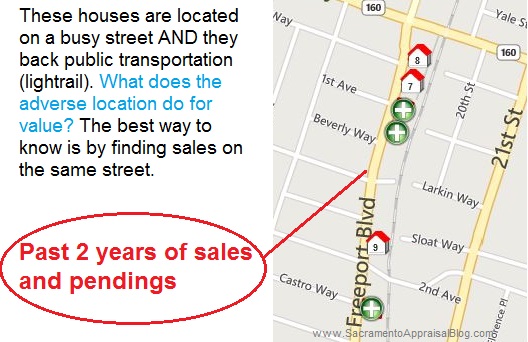
The first thing we want to do is look for sales and listings on the same street. When we have similar sales with roughly the same location, these properties tell us exactly what the market is willing to pay. There is no guessing and no need to use many other sales because we essentially have the best examples of properties that have already been vetted by the market. If we pull sales or listings from a superior street, it’s easy to minimize the adverse location. But if all the sales on the busy street are coming in substantially lower than surrounding sales, the market has spoken. If you don’t have recent sales, you can look at much older sales on the same street, and study other nearby sales at the time to see how much of a value impact there was. If there are zero sales on the subject street, find a competitive busy street in the market area (or maybe even a commercial location or something quasi-similar). There has to be something out there. Also be sure to look at actives, pendings, expired listings and withdrawn listings since they can sometimes give clues on value.
2) Comparing busy vs. not busy:
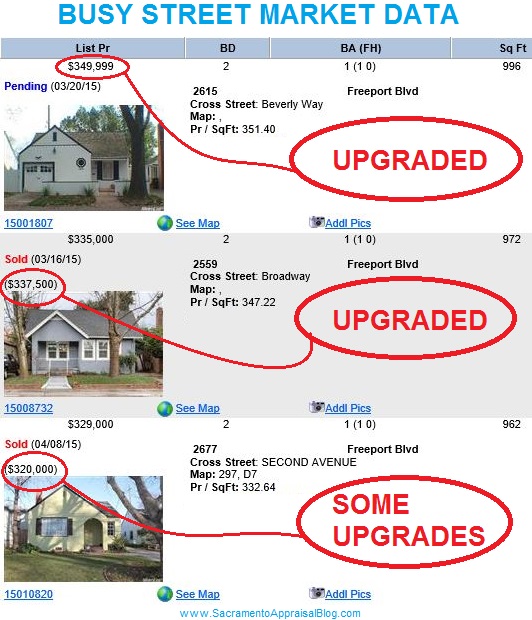
This is where we take a good look at any potential price difference between sales and listings on busy and not busy streets. We have to make sure we are comparing “apples to apples” so to speak, so pay close attention to size, condition, upgrades, lot size, layout, garage space, etc… The goal is to match up several sales instead of just one example because this helps us have a better context of support. In truth we might end up coming up with a range of value for what we think the adjustment should be too. That’s okay. Just ask yourself where your property realistically fits on the range of value spectrum.
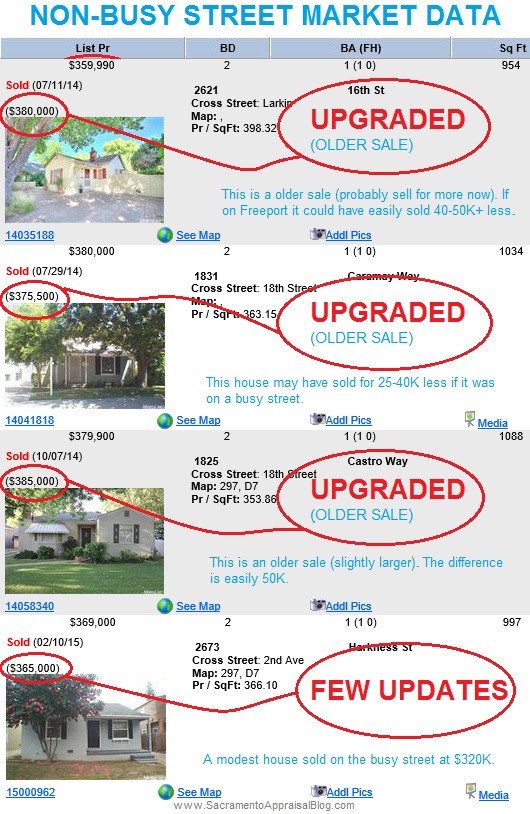
The Verdict: There haven’t been many recent sales in the immediate area lately, which makes it a more involved process to establish value. But even with these older sales, the value difference is fairly large, right? When looking at sales on Freeport Blvd vs competitive sales on typical streets, it looks like the value range is easily anywhere from 25-50K+. If we spent more time on this, we could hone in on a tighter range, but you get the point, right?
NOTE: I am not saying this is the adjustment to give. This is simply a quick snapshot of the market right now for the sake of illustrating a methodology. Remember that these properties on Freeport Blvd also back to public transportation too.
I hope this was helpful. I’d love to hear your take in the comments below.
Questions: Any further insight or stories to share? How have you seen an adverse location impact the value of a property?
This article was originally published HERE for more articles from Ryan Lundquist you can visit sacramentoappraisalblog.com.
If you have any comments or would like to submit content of your own email comments@appraisalbuzz.com
Share this article

Written by : Ryan Lundquist
Ryan Lundquist is a certified residential appraiser in the Sacramento area. Ryan runs the Sacramento Appraisal Blog, which is a top-ranking appraisal blog in the United States. He has been quoted in local and national publications and has been involved with the Sacramento Association of Realtors for nearly a decade. Ryan is also a board member of the Real Estate Appraisers Association of Sacramento. His clients include home owners, real estate agents, governmental agencies, attorneys, and lenders. Ryan also won the Affiliate of the Year award in 2014 from the Sacramento Association of Realtors.
30 Comments
Comments are closed.
I get it, but you now have a 25K spread, so what is the adjustment; $25,000, $50,000, somewhere in between?
Back to the WAG according to this spread.
OMG. That’s all I have to say.
Try $42,000 for busy street; $40/SF; $12K for garage; and 2% for some upgrades and 4% for few upgrades… The time adjustment adjustment suggests prior sales sold for $100/mo more that now, so the statement about “probably sell for more now” lacks support based upon this data… The potential spread is a bit smaller than $25K, more like $~8K, based on the data presented…
Maybe further investigation could reduce that spread… like Ryan said, “If we spent more time on this, we could hone in on a tighter range…”
But then ashurou and everyone else probably knew that…
So for those Buzz readers who are not appraisers, Ryan’s caution appears on point.
The Temptation: It’s easy to use the same adjustments in every neighborhood and in every market, but there is no one-size-fits-all adjustment that will work in every case. This is why we need to know how to research the market.
Thanks Bob. There is certainly room to think critically about issues. Sometimes there really is a range too, and we have to try to justify our adjustments within the range we see (while avoiding the temptation to simply apply that 5K adjustment because that’s what we learned to do (and it has nothing to do with the market)).
It’s somewhere in between. In this case no adjustment would actually have to be made in an appraisal since there are sales on the same street that require no adjustment at all. Yet for the sake of conversation, I showed what other sales were selling for in this neighborhood, and the adjustment was quite substantial. I think we’d have to whittle it down further and spend more time on it to really capture the adjustment.
its more junk data from appraisers who think the have all the answers…junk junk junk
Use comparables on the same street? Who’da thought?
Seriously, this is more complex than using comparable sales on the same street or doing matched pairs. If a house is on a busy street, that implies the possibility of other issues such as zoning, potential zoning change and or expectations of such, trends toward other more intense uses (legal or not), illegal/grandfathered use, degrees of allowable damage to rebuild/repair, concerns about being able to remodel and or change the exterior appearance of the property, street widening, plottage, motivations of purchasers (owner occupants or investors with expectations of future change to other uses), etc., etc.
Yep. There are always complex issues to consider, especially in this case where the property backs public transportation and is on a busy street. It’s a double hit to value.
Wow, can Appraisal Buzz try a little harder to get people to write some fair and pertinent articles. This is getting out of hand. How do you come up with an adjustment for a busy road? You’re kidding right? If you know your market, this is not even an issue.
This article was originally posted on my blog and then re-posted here. This is a basic issue, yet how often do we see a $5000 adjustment when it should be $35,000? This is why the conversation is incredibly relevant.
The fact that this is even an issue that needs to be addressed shows where our industry is at. $5,000. sure if thats what the market dictates. Maybe housing prices are less than $75,000. But this is all relative to where you are. I’m from the San Gabriel Valley, and the effect a busy road can be either a major arterial route or an interior busy road. Typically 3 to 5% for an interior busy road and almost 10% for a major arterial location. The market speaks on a relatively consistent basis and as prices go higher, the higher the degree of effect on marketability . This conversation is only relevant to those appraisers out there who still don’t know what they’re doing. You may see purposes in writing an article like this. To me, its a slap in the face to our industry to think that the very basic concept of an external obsolescence needs to be addressed this way. How poor is the perceived understanding of our work when a core concept, such as the one you’re writing about, needs to be addressed? It makes me upset to be associated with an industry that is perceived to not know what they’re doing. Whatever your degree of competency, I can respect it. I just think there are way more broader and important issues to talk about than this. Must be tough to here critics in an industry of opinionated assholes, **i’m one of them** but a relevant discussion about what can be done to challenge the transitions in our industry that are hurting us or a more proactive series of arcticles where appraiser’s can somehow be empowered would be more relevant at a time where we are losing so much of our to be “appraisers” by the GSE’s. You write an article about the ways to empower the residential appraisal industry, I’ll read it, maybe critique it because of opinions, but support it overall.
It’s good to hear your take @pc4u. Thanks for pitching in your thoughts. I’m sorry to hear you feel this is a slap in the face. It’s certainly not intended that way from me. This wasn’t written because it needs to be addressed, but because it’s interesting to talk about (especially for my original audience on my blog). Personally I would love to see 10 other articles like this to see what other appraisers do to support their adjustments, or how they work with real live properties in their reports. It’s one thing to talk about proper methodologies and valuation principles, but I’d love to see more of them in action. For instance, one of my critiques of many CE courses is they are too theoretical rather than focused on real examples for how to deal with valuation issues. It’s true we might see examples of very bad appraisals, but sometimes we don’t see examples of good ones. Whether we are talking about something very basic or more complex, it would be exciting and possibly relevant to see what other appraisers are doing in their markets. So much of the conversation right now is about supporting adjustments, and while that might not hit your preferred set of topics, it can actually be a good thing for the health of the industry (whether we are talking about matched paired analysis, regression analysis, The Income Approach, The Cost Approach, etc….). Seeing examples of the basics in different markets is very interesting to me, and I welcome more of that over time. I will say one of the takeaways of conversation like this comes with being able to communicate appraisal concepts in a simple fashion to the real estate community at large (this is why the post was so relevant on my blog especially since a big part of my audience is real estate agents). I get where you are coming from about the conversation seeming out of place to a certain extent here because of it’s elementary nature. But hey, I’m glad we’re talking, and I hope something good can come from it.
You seem to be a patient individual and your responses to my ranting is pretty impressive. I’ve had a chance to soak in what you’ve said in the prior two responses and I think one thing that gets lost in appraising is lack of interaction with agents on the field. As an analytical mind, its up to us to separate the marketing garbage and whats true about the marketplace when speaking with real estate agents/brokers. Specifically with regard to busy road adjustments, I’ve found (besides data analysis) that speaking with the agents of properties that sell on busy roads provides insight and validation to what we’re doing. Before going into that conversation, my data is already prepared for the discussion and I will basically broach the subject and ask whether they agree or disagree with my assertion. I.e. “Agent X, my market research indicates that sales along Street Y have a tendency of selling between $40,000 to $60,000 less than an interior residential location such as Z court. How do you feel about that?” The responses I get are great. I don’t rely on agents to give me their feedback to use that figure, I use it as validation towards the data. In that given example, I was probably leaning towards $60,000. But of the agents (atleast 3) that I speak to, they will all come to a relative consensus stating either “$60,000 is a bit agressive, $50,000 sounds about right.” Or on the other hand, $60,000 is a small difference for that location. Its more like $75,000″. These people are the “boots on the ground”. They are speaking with the interested parties that WE call the “market”. I think its imperative that we keep lines of communication with brokers open so that we can verify our info when necessary. You are absolutely correct. Its almost useless when they are teaching matched paired analysis. There is little to no perfect situations on the market and so much of the prices on the market are effected more so by a buyer’s willingness to outbid the market for a good overall property or a market’s allowance of letting it sit because of some factor that we really can’t quantify. Because without data, we can’t apply the appropriate adjustment without red flags going off. I understand the agents are sales people, but its up to appraisers to use our judgement and our analytical abilities to decipher fact from fluff. And personally, after a survey of 5 + agents, if more than 2/3 are saying the same thing, they’re probably right. So beyond the conferring with agents, there’s also the use of retrospective analysis. How does a property on a busy road perform over a period of time. I like going back 2, 3, 4 years when data is limited and even when it is ample, I’d like to see 2 years of performance on that street in comparison to an interior residential location that is competitive to the busy road location. Thats what I think leads to credible results. Like you say, if someone is going to robotically apply a $5,000 or $10,000 adjustment for the pure sake of doing it, is symptomatic of what is hurting the reputation of our industry. But GSE’s making us “appraise in a box” doesn’t necessarily help us out either but maybe its a “chicken or the egg” situation. I am going to look for your blog and check it out. You’ve got my attention, and I want to know what it is you’re writing about. I do feel like we are on relative par, in terms of diligence we would put into an assignment. I will apologize for disrespect towards your article. Hope to learn something from you that can make me better. Thank you Ryan.
Wow pc4u. Thank you sincerely for the comment. Good substance from an appraisal standpoint, but mostly I appreciate your demeanor. I’m so glad we’re communicating. We are in this together. This makes my day. I definitely appreciate you going back in time several years too. I do the same, and I find graphing these sales over time to be an instrumental way to see the market.
But the most important thing: Are the comparables Blue?
I think I can safely generalize for all appraisers out there and simply express horror and outrage at the subject of this article. So condescending and obnoxious to assume that appraisers don’t know how to complete a “simple” matched paired sales analysis. Really, its just insulting! Anyone who didn’t already use this shouldn’t be an appraiser. Maybe that is their point? Has the business digressed to such a degree that appraisers don’t know how to do their jobs? Disgusting. I guess all the good appraisers have been driven out. Reap what you sow, I guess.
Do not even think of generalizing for me, much less anyone else, you idiot. I’d be very willing bet you’re better opening your fat gob than you are at appraising, if you are, in fact, an appraiser.
Ahhh, the ad hominem attack, always useful when you can’t come up with a real argument. I rest my case.
Hey ashurou. This is definitely not condescending. This is a simple concept, yet how often is this concept not applied in our world as appraisers? How often do we see a 5K adjustment for a busy street when it should be significantly more? How many appraisers were taught by their mentors to give these adjustments? How often do we see a $30 GLA adjustment in every single neighborhood? Or it’s always $2500 for that 1/2 bathroom or $1 per sq ft for extra site size. Garage adjustments? 5K. Or we use the same comments to describe the market in every single report despite the market changing over time. This was originally shared on my own appraisal blog, and AppraisalBuzz asked to share it here. I said yes. The interesting part is that this article stirred some great discussion in the comments on my blog as well as several emails from readers. The post was actually very helpful. I have many real estate agent readers, and I had several email me to say, “I had no idea the adjustment could be that high.” I had some other appraisers email too to say, “Hey, this is a good reminder. I’m dealing with something similar right now.” That’s a win in my book because when we open up conversation about how value works in a market, we can all end up learning something. After all, so much of a property’s worth is really just seeing the basic stuff like this in its proper context. We like to think value is ethereal somehow, but in many cases it’s really about properly interpreting the basics (and we know that can be very challenging at times, right?). Moreover, in a culture of canned adjustments, I hope we as appraisers can think through the adjustments we make and whether they are market supported or not. You sound like you are clearly doing a great job as an appraiser, and I commend you for that. I would like to challenge you though to speak more respectfully to other industry professionals. Let’s have each others’ backs as appraisers.
Wow. I can’t believe the condescending comments from those who accuse Ryan of being condescending! JeseeeesMacreeees people. So what if there is a $50K range between properties on the busy/non-busy streets…….you decide what the adjustment should be, just like when you have a range in the adjusted values of the comps, and then decide on a point value for the OMV. I’d like to thank Ryan for posting a relevant article that acts as a good reminder to all of us in how to do analysis. Not ‘every’ adjustment we make is always exactly the same from one report to another…which is a crutch far too many appraiZers get trapped doing just because they are too busy to do proper research. The other aspect of what Ryan wrote is a reason why blowing through report writing and submittal in 57 minutes following a property inspection is absolutely dangerous for the appraiZer, and it’s why demands for 48 hr turn times from clients is also dangerous for them. (there are some staff appraisers for major lenders who do this)
Your right. The writers must have written this article for a more common audience with either no knowledge of the appraisal business or very little experience. I should have considered the possibility that this article was not meant for appraisers currently engaged in the business of appraising. Sorry if I implied that a blog with the title “Appraisal buzz” should have content relevant to the more competent appraisers out there.
Thanks Dave. I appreciate you having my back. The point is we need to put on our appraiser hat. The canned adjustment is the industry standard at $5K or $10K. But what is the real adjustment? This post scrapes the tip of the iceberg rather than trying to whittle down to an exact adjustment. I purposely left a range available so as to not fully solve the issue at hand too (that would make for an incredibly long blog post anyway). The irony here is that many appraisers were never mentored properly to find adjustments in a market. We give lip service to matched pairs and supported adjustments, and we can do better.
For anyone who thinks of me as condescending, know this post was originally shared on my own blog, and then it was re-posted here. Read the post and hopefully you can pick up on a spirit of humility and a care for the real estate community and my appraiser peers. That’s how I roll.
How about a home that sides an arterial, fronts a feeder backs a greenbelt and has high tension wires that intersect above the backyard? One set followed the arterial and the other over the greenbelt.
Answer me that and an appraiser you will be! (Yoda)
Answer:
If you find the best comparables available and bracket everything, all adjustment problems solve themselves.
Nice Yoda reference there Gus. Well said on adjustment problems.
I’ve done a few studies on this very thing. In my market (Dallas-Fort Worth) I’ve noticed that the percentage of resistance to fronting an artery with moderate to heavy traffic goes up as the price range of the properties increases. For example (and not referring to any specific neighborhood or actual research data) in a budget neighborhood the percentage might be 0-5%, & in a custom neighborhood the percentage might be 10-15% plus. Ease of ingress/egress and/or off street parking is another consideration. And I have noticed that if it is a seller’s market the percentage of resistance is lower; in a buyer’s market the percentage of resistance (and days on market) will be higher. In budget rental neighborhoods maybe no measurable resistance; I have had investors mention the marketing advantage of sticking a sign in the yard on Friday afternoon & getting calls off drive home traffic.
Great to hear @terrykileyclark:disqus. Thanks for sharing. I’ve noticed a similar trend in my area. The adjustment can sometimes be more minimal in a “first-time buyer” neighborhood, but much greater in a well established area. I’ve noticed the current market is very sensitive to adverse locations too, so the adjustment becomes a bit greater right now. Even though inventory is sparse, buyers are a bit picky right now about location.
FNMA wants us to double our SF adjustments and your articles seems to indicate that there should be a much larger traffic location adjustment. As a real life appraiser, I have found that adjustments should be smaller or even non-existent in most cases. Buyers cannot make adjustments. They are stuck with what is on the market. They only have an option of yes or no. They cannot say I will offer you $1,000 less if you remove the fireplace or $50,000 more if you remove the traffic behind the home.
When owners do have an option (New Homes) then they do pay full prices for items that cannot be supported on the resale market. They will pay $1,000 for a side garage door, $5,000 for a fireplace, $1,000 for surround sound wiring, $100 per sf for extra GLA, $10,000 for an extra bath, Refuse to buy a home on a busy street, Pay amazing amounts for lot premiums that are insignificant, etc. But in the end it evens out, because those same buyers will not pay for a pool they don’t want, or expensive chef kitchen they do not need or expensive plumbing fixtures or extra cable or electric outlets they do not want.
Let me take summarize some of the excellent point raised in the discussion and add a couple of my own:
1) Adjustments are ALWAYS market-specific. The decrease in value from a busy street may well be a lower percentage in a lower-valued neighborhood and higher in a higher-valued neighborhood.
2) The adjustments will change in strong vs weak markets. In general, in a strong or increasing market (undersupply), the percentage discount for negative factors (like busy streets) will decrease, and in weak markets (oversupply), they will increase. And the inverse is also true: In an undersupplied market, the percentage premium for positive factors will increase and will decrease in oversupplied markets. In an oversupplied market, buyers have more alternatives, so they can tend to avoid homes on busy streets (requiring a higher discount to sell one), and will pay less for something like a view because, again, there are more properties competing with that view property. It’s all about supply and demand.
3) Don’t assume the adjustment is always negative. In high-crime areas, being on a busy street may show a POSITIVE adjustment because it is harder to do anything nefarious at the house without being seen.
4) Calculating adjustments will almost always give you a range, not a magic single number. We have to use our JUDGMENT to reconcile to a single number. And in that $25-50k range, if you use $30k and another appraiser uses $40k, let’s not be so quick to say the other appraiser is “wrong.”
5) Think looking for percentages instead of raw numbers, then applying those adjustments to your comparables. If the indicated percentage in the example given is somewhere around 8-15% for homes in the mid-$300k range, try that same percentage in other markets as a starting point.
I have also used regression analysis to calculate a busy street adjustment. For those familiar with the basics of regression, I downloaded 20 years of sales of homes of a certain age and size range in the neighborhood, then sorted by street name so I could produce one trend line (sales price per square foot over time) for homes on busy streets and another for homes on typical streets. This allowed me to measure the percentage gap between the two lines at various points in time, giving me a range of percentage differences that I could then reconcile into a single percentage.
this is all based on the fact that u KNOW that upgrades play a huge factor…we should always realize we are giving an opinion rooted in some data …its an opinion and the only reason our opinion matters is because the state says it does..knowledgeable and informed buyers opinions matter far more than ours … realtors get far more data from buyers and the data is of greater quality than appraiser data.this said, many realtors cannot interpret and extract this data and this problem is exacerbated by their desire to get paid…people buy for location near work, school districts, because of a large livngi room , a fourth bedroom, a granite countertop, a wall color, etc but we have to come to a conclusion based on gla size, land adjustments , bath/bed, garage bay count, and condition adjustments based on six pictures that obscure that best part of rooms….its an opinion…dont overthink it and dont lie…you’ll be fine